BMO warns investors that the gold/silver ratio could be nearing a historic bottom
NEW YORK (January 15) Speculative momentum continues to provide unprecedented support for silver prices as the market manages to push back above $91 an ounce; however, one bank notes that its performance—particularly compared to gold—could be overdone.
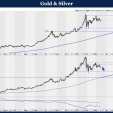
Silver’s recovery and push back toward its recent record highs above $93 an ounce has pushed the gold:silver ratio to 50 points, its lowest level since March 2012. The shift in the ratio has been dramatic after it peaked above 100 points in April 2025.
Silver has benefited from renewed speculative demand that has added to robust industrial demand, igniting supply-chain and liquidity issues and driving a multi-month short squeeze. Last year, silver prices rallied nearly 150%, and prices have continued to push higher during the early days of 2026.
Gold prices, holding support above $4,600 an ounce, are up more than 6% so far this year; meanwhile, silver prices are above $91 an ounce and up more than 27%.
In a note published Wednesday, commodity analysts at BMO Capital Markets said that the ratio has room to move lower; however, shifting supply dynamics could mean the current trajectory is unsustainable.
“While geopolitical uncertainty and demand as a ‘meme investment’ may cause it to fall further in the very short term, we forecast a growing surplus of physical units which will inevitably cause the ratio to increase in the coming years, following a trend which has been sustained since the 1970s,” the analysts said. “Since the end of Bretton Woods in the 1970s, we see a strong causative relationship between the physical surplus and the gold:silver ratio, with periods of large surplus resulting in a steady increase in the gold:silver ratio and vice versa.”
While investment demand has been the main driving force behind silver’s unprecedented rally, BMO said that a better measure of the market’s true supply-and-demand dynamics should consider only consumption.
“When including net physical investment demand, the silver market appears in ‘deficit’, suggesting a drawdown of stocks—but given that the vast majority of stocks are held by investors, this can only make sense if investors are selling physical silver. Our analysis suggests that a better metric to track is the balance between silver consumption (industrial + jewellery + silverware) and supply (which typically exceeds this),” the analysts said.
In the current environment, BMO said that investors need to pay attention to silver consumption in the solar power sector.
“Solar has represented 58% of the increase in silver consumption since 2020; however, due to a combination of plateauing solar installations and persistent silver thrifting in solar technology, silver demand from solar is likely past its peak,” the analysts said.
At the same time, BMO explained that it is too early to determine whether other industrial sectors will pick up the growing slack from the solar sector.
“After many years of being overpromised and underdelivered, there are finally signs that solid-state batteries might be on the horizon—with silver-carbon anode technology a key enabler. We estimate that this could contribute up to 100Moz of silver demand by 2030 if commercialisation efforts by companies like BYD, Samsung, and LG Ensol are successful,” they said.
However, until solid-state batteries are commercially viable, BMO sees an increase in silver supply, which will lead it to underperform gold.
“Even when assuming minimal thrifting and strong demand from the EV space, we nonetheless expect silver's physical surplus to grow over the forecast period. While the ongoing exuberance in the silver sector could cause the gold:silver ratio to spike lower in the coming weeks, we nonetheless expect the long-term trajectory to be firmly upward,” the analysts said.
KitcoNews