Silver may break $125/oz in 2026, Shanghai shortages could cause ‘force majeure’ price shock
NEW YORK (December 30) With silver prices trading above $76 per ounce – and up 2.5x on the year – investors are beginning to get nervous about a potential reversal. But historical analysis of the gold:silver ratio suggests several scenarios in which the gray metal could run significantly higher, and tight supplies where they matter most could also produce a price shock in 2026, according to SilverStockInvestor’s Peter Krauth.
In a recent interview with Kitco News, Krauth said even at these record highs, we may still be relatively early in the silver bull run.
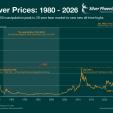
“Silver has taken out its all-time high of $50; this was a 45-year breakout,” he said. “I think we're now going to see $50 become a new floor. These are uncharted waters, so once it broke that $50, it's not too surprising now that we've rallied [to the new highs].”
With silver trading off the historical charts, Krauth said his key gauge becomes its relation to the gold price. He looks at the historical chart of the gold:silver ratio.
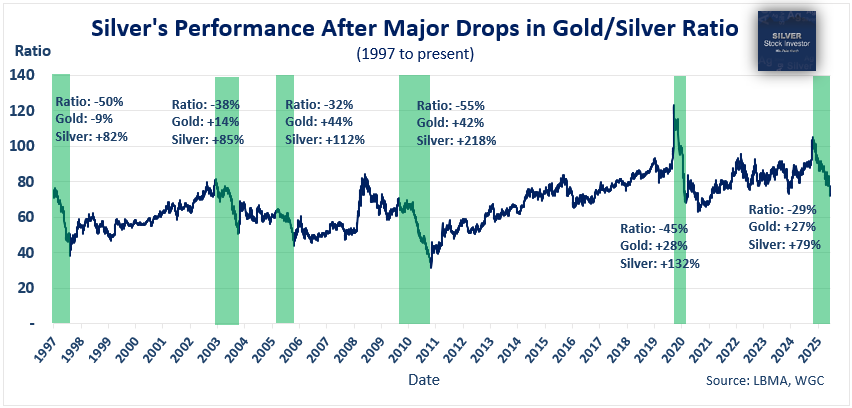
“There were five big drops in the ratio going back to 1997,” he said. “And if you take the average of those, you get a 44% drop in the ratio. So you could argue that the ratio from its recent April peak at about 105, a 44% drop would mean the ratio would go down to about 59, and we're currently at 67. Let's be conservative and say the gold price stays at 4,000. So if you do $4,000 divided by 59, that brings you to $67. We're already there.”
This would constitute a low-end calculation, one in which gold prices pull back to $4,000 support. But even a marginally higher gold price would materially impact that case.
“Let's say it goes to $4,400 and stays there, and my target would be that the gold:silver ratio would drop to about 55, which is probably close to average since 1997 – this would be going to an average level, not even overshooting,” he said. “$4,400 divided by 55 gives you $80. That would bring us to $80 silver.”
This calculation takes us neatly to the very edge of silver’s new high above $82 per ounce before the recent pullback.
But this still does not represent the bullish case. There are plenty of banks predicting gold closer to $5,000 in 2026, with some predicting well in excess of $5,000. Also, these five pullbacks in the gold:silver ratio also saw overshoots; they don’t simply snap back to their long-term average around 55.
“The bullish case would be gold goes to $5,000, and you see the ratio drop to, let's say 45,” Krauth said. “So $5,000 divided by 45, that would give you $111 on silver.”
And 45 isn’t the lowest ratio in recent memory. “Actually, 2011 was the big one; it dropped to 30,” he added. “But you could take even the average of these last four or five drops, and you'd easily get to around 40. So if you do $5,000 gold and divide it by 40, you're looking at $125 silver.”

On the other hand, Krauth’s more bearish scenario would see gold pulling back to support at $4,000 per ounce – or even to key support at $3,800 – meaning silver has already experienced all the overshoot it’s likely to get in the ratio.
“Given the kind of correction we've had in the gold:silver ratio, I wouldn't be surprised to see kind some kind of a reversal, a temporary near-to-midterm reversal,” he said. “I could see it going back to maybe 78 or 80. Let's say gold is at $4,000 and you divide that by 80, you're looking at $50 silver. If you say $3,800 gold and you divide that by 80, you're looking at $47.50. So somewhere around there, in the high forties, would be a downside support level.”
Looking ahead at 2026, Krauth said that while many of silver’s key drivers are well-understood and already priced in – including Fed rate cuts, solar demand, and jewelry sector weakness – he believes the ongoing tightness in silver supply has the potential to produce price shocks that are impossible to time and very difficult to quantify.
“We're at the lowest levels in 10 years in Shanghai,” he said. “We know that London remains very tight. I've been likening this whole thing to a bit of a shell game. It was potentially in short supply in New York, so it moved from London to New York if tariffs were to be applied, so there was this arbitrage. Then we saw tightening up, and it moved back to London again, and then most recently, a bunch of it came from China.”
“This is basically a shell game,” he emphasized. “Moving it around doesn't give you more silver. It just pops up in different places at a given point in time. But you have the same amount of silver under those shells.”
And, as has been pointed out elsewhere, London, New York and Shanghai are not equal and identical in terms of the impact of local shortages on the broader market, because China is where silver’s massive industrial demand is actually consumed. Investors who can’t get paper silver can buy another investment product, but manufacturers supplying solar panels or AI data center servers absolutely need the physical silver.
“It brings us closer to a ‘crying uncle’ point where you have a big industrial user who's holding a contract and says, ‘Okay, I need my 20 million ounces at delivery.’ And [the exchange] says nothing until the last minute, and then they tell them, ‘Sorry. Force majeure. We don't have the ounces. We'll have to settle in cash.’ And the company says, ‘No, I don't want the cash, I need the silver.’ And this makes a major headline. Then you see silver gap up, and it just goes wild.”
“This is the kind of scenario I could see happening, because the Asian holders of these futures contracts, many of them aren't using it to hedge anything,” he added. “They're using it to set themselves up for deliveries of metal. That's what the Shanghai Exchange is meant to be. It's meant to be willing and able to deliver, and that's what's brought it credibility. So that's a really big deal.”
All of this paints a very bullish picture for 2026, one in which the risks are skewed significantly to the upside. And Krauth believes that under these circumstances, individual investors are likely to continue pouring into the silver trade.
“I think that you’ll see a continuation of what appears to be FOMO in the silver market,” Krauth said. “People are starting to realize gold is not only high, but it's above $4,000. People are starting to pay attention. They're saying, ‘Geez, maybe I should own some gold, or maybe I should have bought some gold, and gold is $4,400, or $4,200, that's a lot of money for one ounce of gold. What else can I get? Silver is a lot cheaper for one ounce, and $60 is looking pretty darn cheap compared to $4,200. Maybe I should buy some silver.’”
Krauth said that in these situations, people start to look for an alternative, and even if it's already had a big runup, people will view that alternative as significantly cheaper. “They start to do a little research, and they see that the ratio is still actually pretty high, abnormally high, way above its average,” he said. “Then they say, ‘You know what? Even if gold goes nowhere, silver is likely to continue higher on balance. I'm prepared to jump in at this point.’ I think FOMO is a big part of it.”
KitcoNews