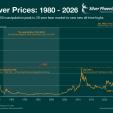
Gold holds $5,000 floor as consumer delinquencies reach highest level since 2017
NEW YORK (February 10) A historic divergence has opened in the U.S. economy, creating a split-screen reality where financial assets appreciate at record velocity while the consumer engine driving the real economy has effectively stalled.
New data released Tuesday paints a stark picture of this economic bifurcation: U.S. retail sales for December came in flat at 0.0%, and consumer delinquency rates climbed to 4.8%—the highest level in nearly a decade. Yet, simultaneously, daily turnover in U.S. equities surpassed the $1 trillion mark, the Dow Jones Industrial Average traded in the 50,000 range, and spot gold established a new floor above $5,000 an ounce.
Will Rhind, Founder and CEO of GraniteShares, told Kitco News anchor Jeremy Szafron that this disconnect is being driven by a massive concentration of global capital flowing into U.S. markets, specifically to chase the artificial intelligence trade.
“The U.S. is the largest capital market in the world,” Rhind said. “A lot of that volume is coming not just from the U.S., it's coming from other markets as well... the only way you can trade Google, trade Nvidia, trade Tesla, et cetera, [is] to come to the U.S.”
The ‘Global Funnel’ Behind the $1 Trillion Turnover
While Main Street struggles with rising delinquency rates - hitting nearly 5% - Wall Street is witnessing unprecedented volume. According to Bloomberg Intelligence, daily equity turnover has eclipsed $1 trillion, a figure Rhind argues is distorted by international liquidity funneling into a handful of U.S. stocks.
Rhind provided critical context on the quality of this volume, noting that it isn't just high-frequency churning, but a structural shift where global investors from markets like South Korea and Australia are forced into U.S. exchanges to access AI growth.
“We tend to see selling when the market is high and buying when the market is low,” Rhind explained regarding the flows in his firm's leveraged single-stock ETFs. Despite the economic headwinds, he confirmed that "creations" - or net new capital entering the system - remain positive this week, signaling that investors are still buying the dips rather than liquidating positions.
The Rise of the ‘Quasi-Sovereign’
The divergence is perhaps starkest in the credit markets. Alphabet Inc. raised $32 billion in debt in a single 24-hour period, including a historic 100-year bond - a maturity timeline previously reserved for sovereign nations.
“We’ve got companies in the world that are in a better financial position than a lot of governments,” Rhind said. He argued that this issuance reflects the massive capital expenditure required for the AI build-out, which he described as “the largest that we will see in our lifetime”.
Rhind dismissed the idea that this signals fear of capital scarcity, suggesting instead that these tech giants are essentially operating with sovereign-grade balance sheets. “They raise money because they can,” he said.
Gold at $5,000: The ‘Abnormal Call’ Becomes Reality
Rhind, who manages the GraniteShares Gold Trust (BAR), acknowledged that a $5,000 gold price target was once considered an extreme outlier.
“10 years ago... that was the Peter Schiffs and people of the world that were talking about $5,000 gold,” Rhind said. “Credit to them, they were right. It was just a question of timing”.
Rhind attributes the current floor in gold prices to steady, rational buying. He noted that while there was a recent frenzy driven by retail investors in China and leverage in offshore markets, the core demand remains robust as gold cements its role as a currency alternative.
“We're living in a world where gold has become the de facto currency alternative to the U.S. dollar,” Rhind stated. “It's surpassed the Euro already in relevance”.
The Metals Outlook: Platinum & Silver
The divergence trade is also lifting other precious metals. Silver was holding near $81.65 on the session at the time of writing, while Rhind identified Platinum - trading at $2,101.00 - as the potential "next metal to go," citing its historical premium to gold which has yet to be recaptured.
“Platinum is still trading... around half or 50% lower than the price of gold,” Rhind noted. “If that could be retaken... there's big upside from here”.
Regarding silver, Rhind highlighted extraordinary activity in the paper market. “Last week, the SLV was trading the most, in other words, the highest volume of any security on the planet... trading more than the S&P 500,” he said.
Bitcoin Decouples from the 'Debasement Trade'
While gold and equities surge, Bitcoin has struggled to reclaim its highs, trading around $69,000. Rhind pointed out a reversal in the liquidity dynamic between the two assets.
“A few years ago... the question [was], ‘Hey, with all of the oxygen going into the Bitcoin market, is that oxygen being taken out of gold?’” Rhind said. “I think today we're asking the exact opposite question.”
Rhind observed that long-time holders are liquidating positions into this rally. “Some of the original holders and largest holders of Bitcoin have been dumping holdings,” he noted, specifically citing selling pressure from the $100,000 level downwards.
Looking ahead, Rhind sees the market continuing to be driven by a handful of dominant tech companies, creating a multi-tiered reality.
“The stock market is not one homogenous thing,” Rhind told Szafron. “The largest tech companies will continue the build-out, will continue the race for AI... The rest of the market, I think, will be dragged along by those companies.”
KitcoNews