After Surging to $121, Is Silver Still A Good Investment?
The question everyone's asking—and what the data actually says


Let's address the elephant in the room.
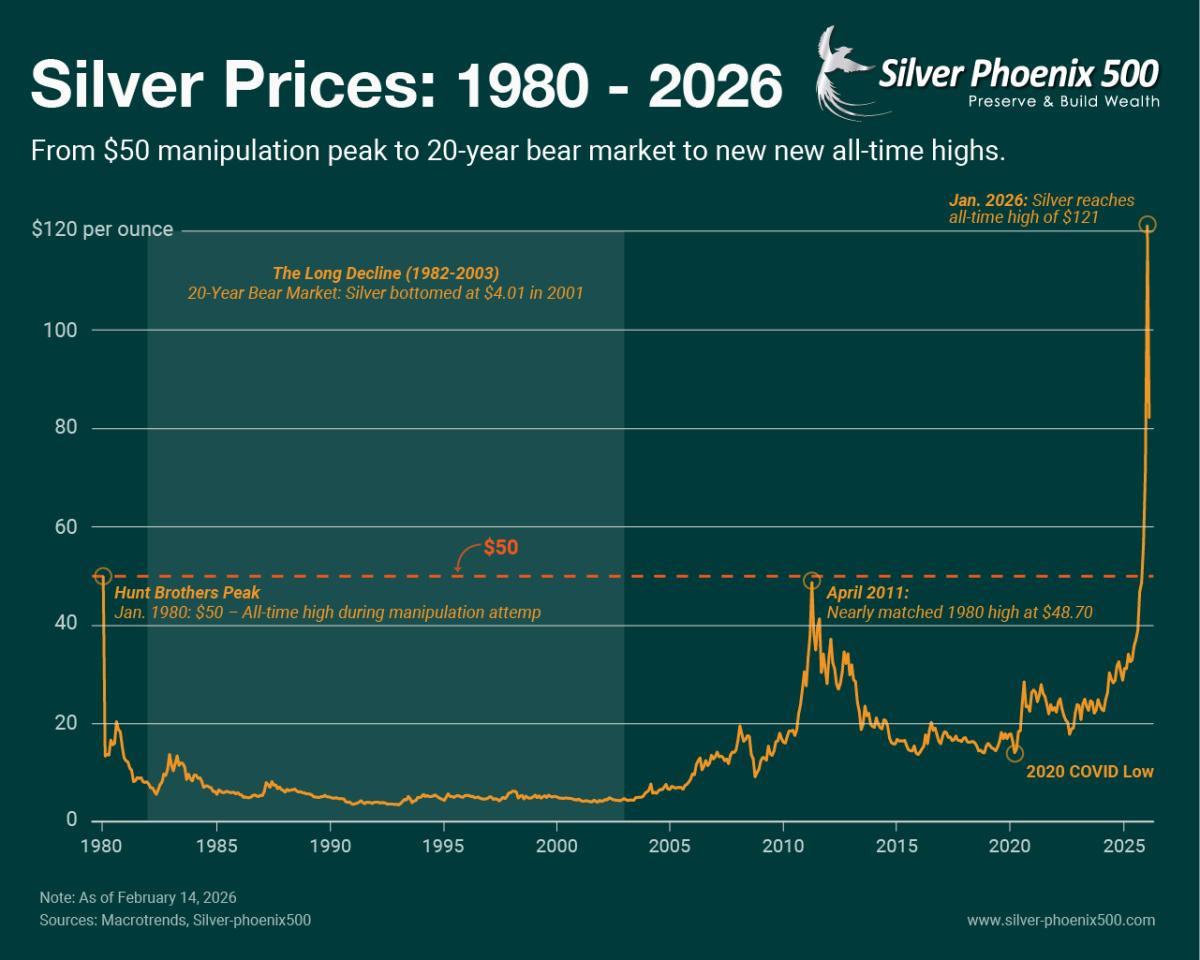
Silver just had one of the most spectacular runs in precious metals history. It surged from below $30 in 2024 to over $121 in January 2026—more than quadrupling in roughly 18 months. It didn't just shatter the 1980 peak—it obliterated it. It crushed the 2011 high. It made headlines globally. It made fortunes for early investors.
And now you're wondering: Am I too late?
It's the most rational question in the world. Nobody wants to be the person who buys at the top, watches their investment crater, and spends the next five years regretting it. We've all heard the horror stories—people who bought Bitcoin at $69k, Tesla at $400, or yes, silver at $48 in 2011.
So here's what I'm not going to tell you: "Buy silver because it's going to the moon!" or "You'll regret it if you don't buy NOW!"
Here's what I am going to do: walk through the actual data, the fundamentals that drove the rally, whether those fundamentals still hold, what could go wrong, and how to think about position sizing after a major move.
Because the truth is: sometimes assets are expensive for a reason. And sometimes what looks like "late" is actually early in a longer trend.
Let's figure out which one this is.
The Uncomfortable Truth About Buying After Big Moves
First, let's acknowledge the psychological challenge here.
When silver was $24, nobody cared. When it hit $35, people started paying attention but thought "I'll wait for a pullback." At $50, the headlines started. At $70, FOMO kicked in. At $93, everyone's watching. Then at $121, pure mania—followed by a sharp correction that's had silver currently whipsawing between the high $70s and low $90s.
This is completely normal. And it's exactly why most investors underperform—they wait for confirmation (which comes after the move), then buy near the top out of fear of missing out, then panic sell when it corrects.
So let's do the opposite. Let's remove emotion and look at what actually matters: fundamentals, valuation context, and risk management.
The $121 Spike and Volatile Correction: What Just Happened?
 Before we dive into fundamentals, let's address the volatility elephant in the room.
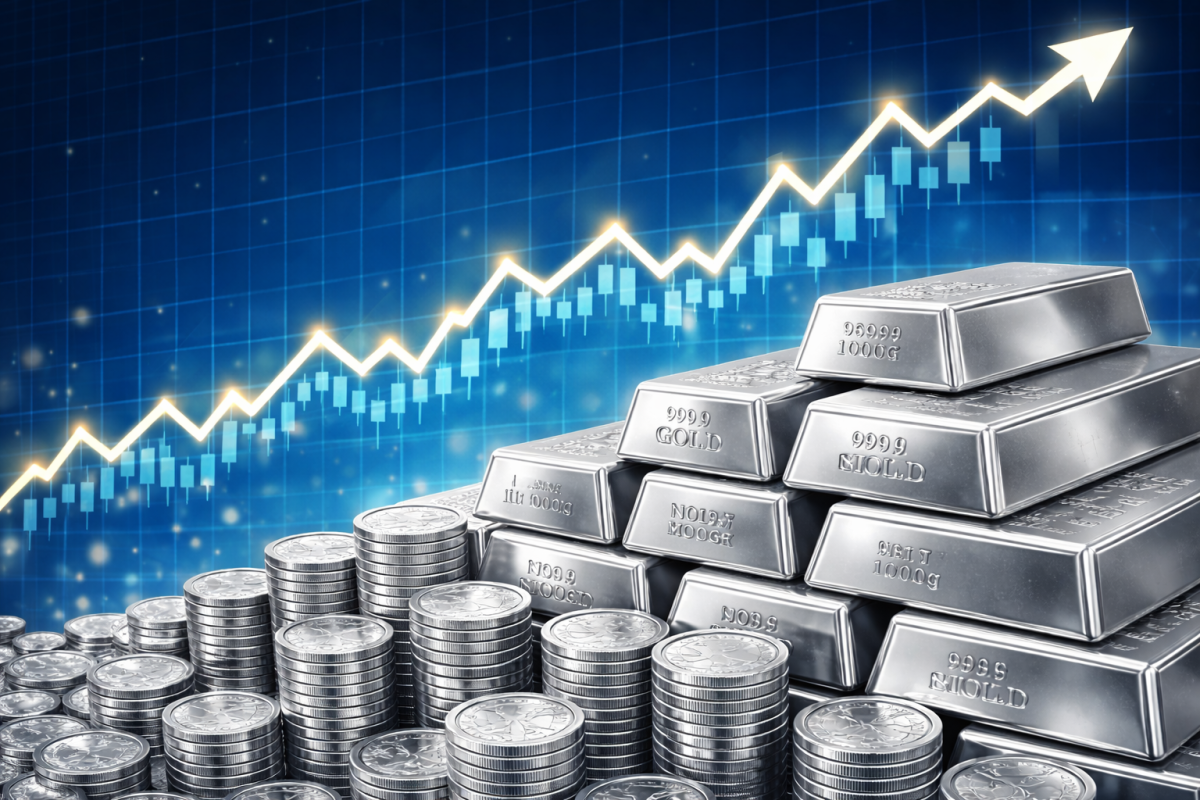
Silver hit $121 on January 29th. Then it crashed. Hard.
Within days it was back in the $90s. Then the $80s. Just recently it dropped below $80 for the first time since the spike. As I write this, silver has been whipsawing between the high $70s and low $90s—wild daily swings that would give most investors heart palpitations.
If you're reading this thinking "See, I knew I was late! It was a blow-off top!"—I understand the impulse.
But let's pause before drawing that conclusion.
This type of volatility is completely normal for silver. In fact, it's a feature, not a bug. During the 2009-2011 rally from $12 to $48, silver experienced multiple 20-30% corrections along the way. The path was never straight up. The volatility was relentless.
What matters isn't whether silver corrects—it always does, often violently. What matters is whether the fundamental drivers that pushed it to $121 remain intact.
So let's examine exactly that: Are the same forces that drove silver from $24 to $121 still in place? Or was the spike to $121 a euphoric blow-off top signaling the end of the move?
What Actually Drove Silver's 2025 Rally?
Before we can answer "is it still a buy," we need to understand "why did it rally in the first place."
Because if the rally was speculation, hype, or a short squeeze—yeah, you're probably late. But if it was fundamental repricing based on structural market changes, that's a different story.
Here's what drove the move:
1. Five Years of Supply Deficits (Not One, Not Two... Five)
This isn't a temporary imbalance. From 2021 through 2025, the silver market has been in deficit every single year:
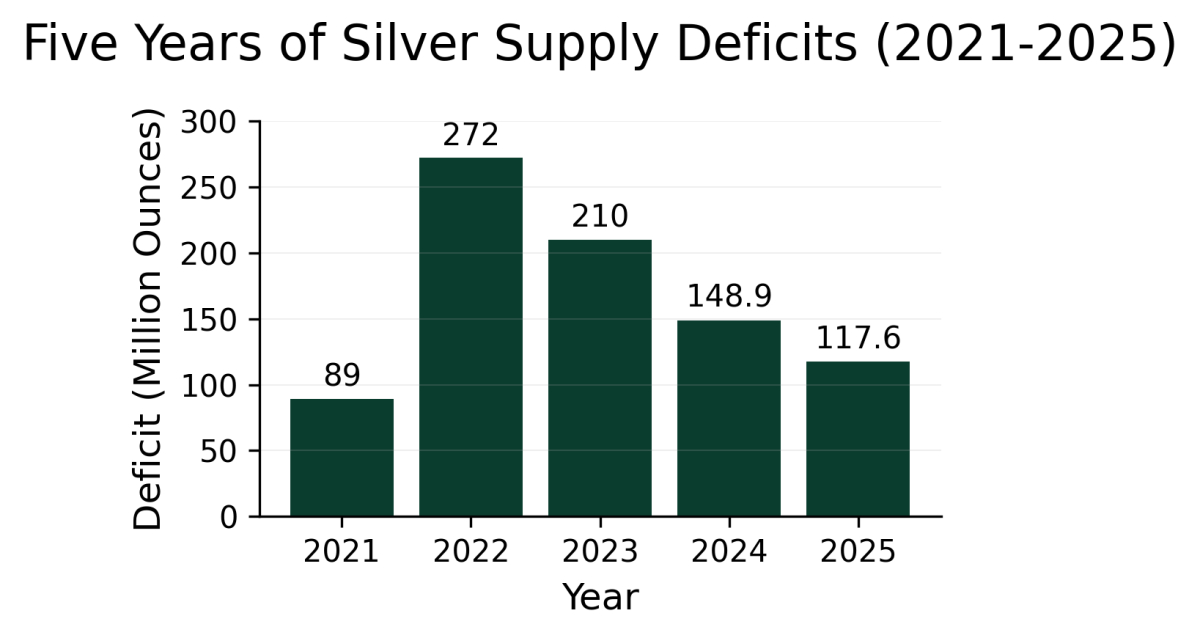
- 2021: Deficit (89 million ounces)
- 2022: Deficit (272 million ounces)
- 2023: Deficit (210 million ounces)
- 2024: Deficit (148.9 million ounces)
- 2025: Projected deficit (117.6 million ounces)
Cumulative five-year deficit: Nearly 800 million ounces.
To put that in perspective, that's equivalent to 10 months of global mine production just... gone. Drawn from inventories. Consumed and not replaced.
Now, you might think: "Okay, but prices tripled. Surely that brings on new supply, right?"
Wrong.
Mine production grew a whopping 0.9% in 2024. Less than one percent. Despite silver going from $24 to over $120.
Why? Because 72% of silver is a byproduct of mining other metals—primarily copper, lead, and zinc. Miners don't decide to "mine more silver" when silver prices rise. They mine copper or lead, and silver comes along for the ride.
This is fundamentally different from most commodities where high prices quickly incentivize new production.
2. Industrial Demand Hit Record Highs (And Keeps Growing)
Here's where it gets interesting.
Industrial demand in 2024: 680.5 million ounces.
That's not just high. That's a record. For the fourth consecutive year.
And unlike investment demand (which is fickle and can disappear overnight), industrial demand is sticky. Companies building solar panels don't care if silver costs $25 or $95—they need it to function.
The demand breakdown:
- Solar panels: 197.6 million ounces (19% of total demand)
- Electronics: Massive and growing (AI, data centers, 5G)
- Electric vehicles: Nearly double the silver of traditional cars
- Medical applications: Antimicrobial uses expanding
59% of silver demand is now industrial. That's up from about 40% two decades ago.
This creates a price floor that didn't exist in previous silver cycles. In 2011, when silver hit $48, it was mostly speculation and investment flows. When those reversed, silver collapsed.
Today? Companies are legally mandated by government policies to install solar capacity. Auto manufacturers have committed to EV production targets. Data centers need to be built for AI infrastructure.
This demand isn't optional. It's structural.
3. The Gold-Silver Ratio Screamed "Buy Silver"
In late 2023 and early 2024, the gold-silver ratio exceeded 80:1—a level that has historically preceded significant silver outperformance.
The ratio hit 125:1 during the COVID panic (an all-time extreme). It sat in the 80-85 range for months in 2023-2024.
What happened next was textbook mean reversion: silver surged 147% in 2025 while the ratio compressed.
This wasn't lucky timing. This was a signal that's worked repeatedly throughout history finally playing out again.
The ratio's behavior during this rally followed a classic pattern. If you want to understand how to use the gold-silver ratio for timing—including the 80/60 trading rule and where the ratio stands after the recent volatility—I wrote a detailed analysis here: The Gold-Silver Ratio Explained: How to Use the 80/60 Rule
4. Critical Mineral Designation Changed the Game
In 2025, the U.S. government officially designated silver as a critical mineral—the same category as rare earth elements essential to national security.
This isn't symbolic. It means:
- Government support for domestic production
- Strategic stockpiling considerations
- Priority in trade policy
- Recognition that America can't function without it
When was the last time the government declared a precious metal "critical to national security"?
Yeah. This is new.
So... Is the Rally Over or Just Beginning?
Here's where we need to be honest: nobody knows for certain.
Anyone who tells you they know exactly where silver goes next is lying, delusional, or selling you something.
But we can evaluate probabilities. We can look at what typically happens after rallies driven by fundamental changes versus rallies driven by speculation.
The Bear Case: Why You Might Be Late
Let's steelman the argument against buying here:
We Just Witnessed Classic Blow-Off Top Behavior" Silver spiked to $121 and has since crashed back to the high $70s—a 35%+ correction in less than three weeks. It's now whipsawing violently with 5-10% daily moves. This looks exactly like the aftermath of the 1980 peak at $50 and the 2011 peak at $48.70. Both times, silver never saw those levels again for over a decade. Maybe $121 was the euphoric top, and everyone buying now is catching a falling knife. The violent volatility suggests the market is rejecting higher prices.
Prices Have Already Adjusted The market isn't stupid. Silver quadrupled, spiked to $121, then corrected. Maybe the fundamentals are already fully priced in. Maybe current levels in the high $70s to low $90s represent fair value—or even overvaluation.
Profit-Taking Is Natural After quadrupling from the 2024 lows, early investors are sitting on massive profits.
Economic Slowdown Could Hurt Industrial Demand If we hit a recession, solar panel installations might slow. EV sales could decline. Electronics demand could soften.
Volatility Could Be Painful Silver is roughly 2-3x more volatile than gold—and you're seeing it in real-time. We just watched $121 become sub-$80 in three weeks. Can you stomach more of this? Another 20-30% drop from current levels would mean $55-65 silver.
Previous Rally Tops Took Years to Reclaim Silver hit $50 in 1980. Didn't see those levels again for 31 years. Hit $48.70 in 2011. Took 13 years to break through. What if this time is similar?
These are all valid concerns. Let's not dismiss them.
The Bull Case: Why This Could Be Early
Now the counterargument:
"Supply Can't Respond Quickly" Unlike previous cycles, today's supply constraints are structural. Even at $120+, production barely responded. New mines take 5-8 years. The byproduct constraint means you can't just "mine more silver."
This suggests deficits persist even at elevated prices.
"Industrial Demand Is Policy-Driven" The European Union has legally mandated 700 gigawatts of solar capacity by 2030. China increased solar capacity 45% in 2024 alone. U.S. infrastructure bills fund massive renewable buildouts.
These aren't market trends that can reverse—they're government mandates. The solar panels will be built. They will consume silver. End of story.
"We're Still Below Inflation-Adjusted Highs" Silver's 1980 peak of $50 equals approximately $170-180 in today's dollars.
Gold, by contrast, has already exceeded its inflation-adjusted 1980 peak.
This suggests silver still has significant room to run just to match historical real values.
"The Deficit Math Doesn't Work" Let's do simple arithmetic:
- Annual demand: ~1.16 billion ounces
- Annual supply (mine + recycling): ~1.01 billion ounces
- Deficit: ~150 million ounces per year
At current consumption rates, where does that 150 million ounces come from? Inventories. Which are being depleted.
What happens when inventories run critically low?
Prices have to rise enough to either:
- Destroy demand (force industrial users to find substitutes—difficult for silver's applications)
- Incentivize massive recycling (requires much higher prices)
- Bring on new mine supply (takes years and isn't guaranteed)
Industry analysts forecasting prices "well into the hundreds of dollars per ounce" aren't being sensational. They're doing the math.
"This Time Actually IS Different" I know, I know. "This time is different" are the four most dangerous words in investing.
But consider:
- 2011 rally: Primarily investment/speculation driven. 50% industrial demand.
- 2025 rally: Structural industrial demand shift. 59% industrial demand.
When silver crashed from $48 in 2011, investment demand could (and did) evaporate overnight.
Can solar panel manufacturers stop buying silver overnight? Can EV production lines shut down? Can data centers stop being built?
The demand composition genuinely is different. That creates a different dynamic.
"Violent Corrections Don't End Fundamental Bull Markets" Yes, silver spiked to $121 and crashed. Yes, it's now whipsawing between the high $70s and low $90s with stomach-churning volatility.
But corrections—even violent ones—don't end bull markets driven by fundamentals. Broken fundamentals end bull markets.
Consider the 2009-2011 rally from $12 to $48. It experienced FOUR separate corrections exceeding 25%:
- September 2009: -28% correction
- January 2010: -27% correction
- May 2010: -25% correction
- December 2010: -26% correction After each one, people declared the rally over.
After each one, silver resumed climbing—eventually reaching $48, a 300% gain from the start.
Then it crashed for real. But that crash came when the fundamentals broke: investment demand evaporated, industrial demand was only 40% of the total, and there was no structural supply deficit.
Today? Industrial demand is 59% of total demand and still growing. Five consecutive years of supply deficits. Critical mineral designation. Policy-mandated solar installations.
The spike to $121 may have been too far, too fast. The correction may continue. But if the fundamentals remain intact—and they do so far—then this volatility is the price of admission to a fundamental bull market, not the end of it.
The real question: can you stomach this volatility? Because if the bull case is right, there will be more of it.
The Inflation-Adjusted Context That Changes Everything
Let me show you something that puts this in perspective.
Silver's nominal price history:
- 1980: $50 (Hunt Brothers peak)
- 2011: $48.70 (post-financial crisis peak)
- 2026: $121+ (current all-time high, January 29th)
Looks like we are at unprecedented levels, right?
Now adjust for inflation:
- 1980's $50 = $170-180 today
- 2011's $48.70 = $68-72 today
- 2026's $121 peak = $121
- 2026’s current range = high 70s to low $90s
Wait. So in real purchasing power terms:
- Even at the $121 peak, we were still 29-33% below the 1980 inflation-adjusted high
- At current prices in the high $70s, we're only 7-13% above the 2011 inflation-adjusted peak
- We established a new nominal high at $121, but never approached the real inflation-adjusted peak from 1980
 This completely changes the framing.
Even after silver's surge to $121, we never approached the inflation-adjusted 1980 high of $170-180. And with silver now trading in the high $70s to low $90s after the correction, you're buying at levels barely above the 2011 inflation-adjusted peak—and still roughly 50-55% below the 1980 real high.
You're not buying at an all-time high in real terms. Even if you'd bought at the $121 peak, you'd have been paying only 67-71% of the 1980 inflation-adjusted high.
Does this guarantee silver hits $170? Of course not. But it provides crucial context that we're not in uncharted valuation territory, even after the rally to $121.
What History Says About Buying After Big Moves
Let's look at what actually happened to people who bought silver after significant rallies:
Case Study 1: Bought in 1979 (During the Rally to $50)
The situation: Silver was already up significantly, trading in the $20s and $30s during 1979 before the final spike to $50 in January 1980.
What happened:
- If you bought at $30 in late 1979: You saw a brief spike to $50, then a catastrophic crash to $10. Disaster.
- Outcome: Took 31 years to break even nominally, never recovered in real terms.
What was different: Pure speculation. Hunt Brothers manipulation. No industrial demand support. Completely unsustainable.
Case Study 2: Bought in 2009-2010 (During the Rally to $48)
The situation: Silver was rallying from the 2008 lows around $10, trading in the $15-25 range through 2009-2010.
What happened:
- If you bought at $20 in 2010: You saw gains to $48 (140% profit), then a painful decline back to the $15-20 range for years.
- If you held through: You saw it reach $121 before correcting back to current levels in the high $70s to low $90s—still a massive win from your $20 entry.
- If you sold the spike at $40+: You made 100%+ returns.
Outcome: Patient holders eventually won big. Traders who tried to time it had mixed results.
Case Study 3: Bought During the 2024-2026 Rally (That's You, Right Now)
The situation: Silver breaking above $30 for the first time since 2013, building momentum through 2024 and 2025, spiking to $121 in January 2026, then correcting violently.
What happened at different entry points:
If you bought at $30 in early 2024:
- You saw it spike to $121 (+303%)
- Then watched it whipsaw back to the high $70s (still up 150%+)
- You've endured massive volatility but remain deeply profitable
If you bought at $50 mid-rally:
- You saw it spike to $121 (+142%)
- Then watched it correct to the high $70s (still up 50%+)
- You're still winning, but the ride has been nauseating
If you bought at $70 as momentum built:
- You saw it spike to $121 (+73%)
- Then watched it fall back to the high $70s (now roughly breakeven to slightly up)
- You're questioning everything about your life choices
If you bought at $90-100 late in the rally:
- You saw it spike to $121 (up 10-21%)
- Then watched it crash below your entry (now down 10-20%)
- You're experiencing the exact fear this article addresses
If you bought the $121 top:
- You're down 30-35%
- You're in pain
- But the question is: are you early in a longer trend, or did you catch the top?
Outcome: This is still unfolding. We don't know yet if $121 was "the top" or just a spike in an ongoing bull market. What we do know is that even late buyers who entered in the $70-90 range are either still profitable or close to breakeven despite the violent correction.
The Pattern That Matters
When rallies are driven by fundamentals rather than speculation, they tend to:
1. Go further than anyone expects
2. Experience violent corrections along the way (we're seeing this now)
3. Resume if the fundamentals remain intact
4. Eventually reward patient holders who can stomach the volatility
So the question isn't "did silver correct violently from $121?" (it obviously did).
The question is: "Are the fundamentals that drove it to $121 still intact, or have they broken?"
Let's examine that.
How to Think About Position Sizing Now
Okay, so you're convinced there's a case for silver. But how much should you allocate after such a dramatic rally—and amid ongoing volatility?
This is where the rubber meets the road—and where most investors either protect themselves or set themselves up for regret.
The truth is, position sizing after a major rally isn't about picking a magic percentage. It's about aligning three things: the strength of the fundamental case, your personal risk tolerance, and your investment timeline.
How you balance these factors—whether through dollar-cost averaging, waiting for consolidation, or establishing core versus trading positions—depends on your specific situation and how you handle volatility. The framework for making these decisions, including specific allocation ranges based on conviction levels and tactical entry strategies, is something I break down in detail in The Silver Investing Guide.
What I will say here: if the fundamentals are compelling enough to warrant exposure (and I believe they are), but the rally has been dramatic enough to warrant caution (which it has), then some form of measured, staged entry makes more sense than either going all-in or staying completely out.
The worst mistake? Letting FOMO drive a concentrated position you can't psychologically handle, or letting fear keep you completely on the sidelines while structural fundamentals play out.
What Could Go Wrong? (The Honest Risk Assessment)
Let's be real about the risks, because they're significant:
Volatility is extreme. You're seeing it right now—wild swings after a dramatic rally aren't just possible, they're normal for silver.
Technological disruption exists. What if solar panels evolve to use less silver? What if substitutes emerge? Unlikely near-term, but possible over 5-10 years.
Economic cycles matter. A severe recession could temporarily hit industrial demand, even if policy mandates remain.
You might just be wrong. Maybe the deficit narrative is overstated. Maybe recycling ramps faster than expected. Maybe production responds.
The key isn't whether these risks exist—they do. The key is how you structure your position to survive them if they materialize, and how you monitor indicators that would tell you the thesis is breaking. That's exactly what I walk through in The Silver Investing Guide: the specific risk scenarios, how to position for them, and what signals would indicate it's time to reduce or exit your position.
For now, just know: these risks are real, and anyone telling you silver only goes up from here is selling you something.
The Question Behind the Question
What you’re actually asking is: "Will I look stupid if I buy now and it drops?"
And look, I get it. Nobody wants to be that person.
But here's the thing: you could also look stupid for NOT buying if it runs to $150. Or $200.
The real question isn't "will I look smart or stupid." The real question is: "Based on the available evidence, what's the highest probability outcome, and how do I position myself to benefit while managing downside risk?"
And that question has a less anxiety-inducing answer:
The fundamentals that drove the rally largely remain intact. Supply deficits persist. Industrial demand continues growing. The inflation-adjusted context suggests room to run. But volatility is real, timing is uncertain, and position sizing matters.
Therefore: Get exposure through dollar-cost averaging or waiting for consolidation, size appropriately for your risk tolerance, and accept that you might endure painful volatility along the way.
Not as sexy as "BUY NOW IT'S GOING TO $300!" But more honest.
What I'm Watching Going Forward
If you do decide to take a position, here's what I'm monitoring to assess whether the thesis remains intact:
Quarterly supply-demand data from the Silver Institute
- Are deficits continuing?
- Is industrial demand still growing?
Solar installation rates
- EU, China, and U.S. solar deployment numbers
- These drive nearly 20% of silver demand now
Mine production reports
- Is production finally responding to higher prices?
- Any major new mines coming online?
The gold-silver ratio
- Has it compressed to levels suggesting silver is now overvalued versus gold?
- Or is there room for further compression?
Recession indicators
- If economic slowdown hits, industrial demand could soften
- Though silver might still outperform as a safe haven
Inventory levels
- How much readily available silver remains?
- Are we approaching critically low levels that could trigger supply squeezes?
If these indicators start deteriorating—deficits shrinking, demand falling, production surging, ratio compressing to sub-50 levels—that's when I'd consider reducing exposure.
Until then, the fundamental case remains compelling.

Where We Actually Are Right Now: The Post-$121 Reality
Let's get concrete about the current situation, because this is where theory meets reality.
As of mid-February 2026, here's the state of play:
What happened:
- Silver spiked to $121 on January 29
- Corrected sharply to the low $90s within days
- Dropped below $80 just recently
- Currently whipsawing between high $70s and low $90s
- Daily volatility of 5-10% has become normal
What this creates:
Three possible scenarios for how this plays out:
Scenario 1: $121 Was the Top (The Bear Case Wins)
The spike was a blow-off top driven by speculation and momentum, not fundamentals. The violent correction and ongoing volatility signal that the market is rejecting higher prices. From here, silver continues grinding lower—back to $70, then $60, then perhaps $50. The supply deficit narrative was overhyped. Industrial demand growth slows. Substitution accelerates. In this scenario, buying now means catching a falling knife.
Probability if: Supply deficits shrink, industrial demand declines, mine production surges, recession hits hard.
Scenario 2: We're Building a New Base (The Bull Case Wins)
The fundamentals remain intact, but the move to $121 was too far, too fast. The market is now consolidating in the $75-95 range, building a base for the next leg higher. This volatility is painful but normal—similar to the four major corrections during the 2009-2011 rally. Once silver establishes firm support (probably in the $75-85 range), the next move targets $130+, then potentially $150-200 as supply deficits persist and industrial demand keeps growing. In this scenario, current prices represent an entry opportunity.
Probability if: Deficits continue, industrial demand keeps growing, mine production stays flat, inventory levels decline further.
Scenario 3: Extended Consolidation Before Next Move (The Patience Case)
Silver needs 6-12 months to digest the gains and work off the speculative excess from the $121 spike. It chops around in a wide range—maybe $70-100—frustrating both bulls and bears. Then, in late 2026 or early 2027, as the fundamental case reasserts itself and volatility settles, it resumes the uptrend. In this scenario, there's no rush to buy, but the fundamental case remains valid for patient investors.
Probability if: Mixed signals—deficits persist but at lower levels, demand growth continues but moderates, economic uncertainty keeps sentiment choppy.
Which scenario is most likely?
I can't tell you with certainty—anyone who claims they know for sure is lying to you.
But I can tell you what I'm watching to determine which scenario is playing out:
If you see supply deficits shrinking, industrial demand declining, and mine production surging → Scenario 1 is winning
If you see deficits persisting, demand growing, production flat, and silver building clear support in the $75-85 range → Scenario 2 is winning
If you see mixed data and choppy, range-bound price action for months → Scenario 3 is winning
The fundamentals will tell us which scenario plays out.
The bottom line for right now:
If you're considering buying silver in the high $70s to low $80s after the correction from $121, you're either:
- Getting a great entry point in an ongoing bull market (Scenario 2), or
- Establishing a patient position that will consolidate before moving higher (Scenario 3), or
- Catching a falling knife in a market that's topped (Scenario 1)
The answer depends entirely on whether the fundamentals hold.
And so far? They're holding.
Final Thoughts: The Regret Minimization Framework
Here's a mental model that might help:
Imagine it's five years from now. Silver is at $200. How do you feel?
If you bought in the high $70s after the correction: "Glad I got in during the volatility, even if it wasn't the exact bottom" If you didn't buy: "Man, I wish I'd acted when all the fundamentals were lining up and price had pulled back from $121"
Now imagine silver is at $50. How do you feel?
If you bought in the high $70s: "That was painful, but I sized appropriately and survived it"
If you didn't buy: "Dodged a bullet, glad I waited"
The Bottom Line
Is silver still a good investment after surging to $121?
My answer: Yes, for investors who:
- Understand the fundamentals driving demand (and see they're still intact)
- Appreciate the supply constraints (which haven't changed)
- Can handle extreme volatility (you're seeing it right now—can you stomach more?)
- Size positions appropriately (especially critical given current volatility)
- Have investment horizons of 3+ years (short-term is pure gambling at this volatility level)
- Use dollar-cost averaging or wait for clear consolidation (don't try to catch the exact bottom)
- Accept that $121 might have been the top, but believe the odds favor it being a spike in a longer trend
No, for investors who:
- Are chasing performance without understanding why it happened
- Need the money in the next 1-2 years (volatility makes this sketchy)
- Can't stomach 30-40% drawdowns (we just saw one, and there could be more)
- Are trying to get rich quick (this volatility may destroy you)
- Haven't done their homework on the risks (this is not the time for blind buying)
- Believe silver only goes up from here (it won't—the path will be volatile both ways)
The fundamentals that drove silver from $24 to $121 haven't disappeared. Five years of deficits. Record industrial demand. Structural supply constraints. Critical mineral status. Inflation-adjusted upside potential.
But the path forward clearly isn't straight up—you're watching that play out in real-time with the violent swings between the high $70s and low $90s. Volatility isn't theoretical anymore. It's your daily reality if you own silver.
The opportunity isn't gone. But the easy money definitely is.
What remains is a compelling fundamental case that requires conviction, patience, and the stomach to endure gut-wrenching volatility.
Now you have the data. The decision is yours.
Want the Complete Picture?
This article covered whether silver is still a buy after the rally—but it's just one piece of a comprehensive investment decision.
To fully evaluate silver as an investment, you also need to understand:
The complete fundamental story:
- Detailed breakdown of the 5-year supply deficit (how bad is it really?)
- Industrial demand trends by application (which sectors are growing fastest?)
- Why production can't respond even at $120+ silver (the byproduct constraint explained)
- What analysts forecast and the methodology behind those targets
Investment strategy and execution:
- Physical bullion vs. ETFs vs. mining stocks vs. IRAs (which is right for you?)
- Portfolio allocation frameworks for different risk tolerances
- How to use the gold-silver ratio for tactical timing
- Rebalancing strategies and when to take profits
Risk management approaches:
- How to position size after a major rally
- Managing volatility in your portfolio
- Exit strategies if the thesis breaks
- Tax implications of different investment vehicles
I spent three weeks compiling all of this into The Silver Investing Guide—a comprehensive 54-page analysis of where silver stands after the historic rally to $121 and what comes next.
The guide is free.
Get The Silver Investing Guide (Free)
Inside you'll find:
- Complete supply-demand analysis with sources and data
- The rally breakdown from $24 to $121 (what drove it and whether fundamentals persist)
- Gold-silver ratio strategy with historical validation
- Investment methods comparison (physical, ETFs, miners, IRAs)
- Portfolio management frameworks
- Inflation-adjusted analysis and price forecasts
- Risk assessment and mitigation strategies
Whether you decide to buy silver at current levels or wait for a better entry point, the guide provides the complete analytical framework to make an informed decision.
By downloading the guide, you'll also receive daily silver news, market analysis, and commentary. Unsubscribe anytime.

Darren Capriotti brings over a decade of specialized market analysis experience to the precious metals sector, with particular expertise in gold and silver market dynamics. His analytical foundation was built during his early career as a commodities research analyst for a mid-tier investment firm, where he developed sophisticated models for tracking precious metals price movements and supply chain disruptions. His background in econometrics and statistical modeling, coupled with extensive field research into mining operations across North America, provides him with an unusually comprehensive perspective on precious metals markets. You can reach Darren at dcapriotti@gold-eagle.com.
More from Silver Phoenix 500