Peter Schiff Says Fed Reversal, Inflation Clash With Trump, and Silver Surge Point to a Volatile 2026
NEW YORK (December 24) As markets move toward 2026, Peter Schiff says the Federal Reserve has quietly returned to the policies that fueled past inflation shocks, even as political leaders publicly dispute whether inflation remains a problem. The debate has recently spilled into a high-profile exchange between Schiff and President Donald Trump, underscoring the growing gap between official messaging and market signals.
Speaking with Kitco News, the chief economist at Euro Pacific Capital said the Fed’s new program to purchase $40 billion in Treasuries each month marks a renewed phase of debt monetization that is already reshaping inflation expectations, precious metals markets, and investor behavior. “I don’t care what they call it,” Schiff said. “It is just debt monetization. It’s inflation.”
Fed Treasury Buying Signals Deeper Financial Stress
The return to balance sheet expansion reflects stress beneath the surface of the financial system, particularly in the banking sector, according to Schiff. While the current program focuses on short-term Treasuries, he expects it to grow in both size and duration. “Sometime next year, maybe even the first half of next year, they’re going to end up expanding that to more than $40 billion, and they’re going to extend the maturities on what they’re buying,” he said.
He argued that the Fed’s reluctance to label the program as quantitative easing reflects a credibility problem, and acknowledging a return to QE would signal that the economy has become dependent on permanent money creation. “It’s like a habit that we can never quit,” Schiff said, adding that the Fed’s balance sheet could exceed $10 trillion in 2026 after peaking near $8 trillion during the previous cycle.
Schiff also warned that banks are more fragile than headline data suggest, noting that large unrealized losses remain unmarked and that Treasury purchases may be acting as a backstop rather than a routine liquidity operation.
Schiff’s inflation warnings have drawn a direct response from President Donald Trump. After Schiff appeared on Fox and Friends Weekend earlier this month, Trump criticized him in a December 6 Truth Social post, calling him a “Trump-hating loser” and a “jerk,” while rejecting the claim that prices are rising. Trump, in his post, pointed to gasoline prices hitting $1.99 per gallon in some states and said prices were “coming substantially down.”
Schiff pushed back on that narrative, arguing that focusing on fuel prices ignores broader affordability pressures. “Inflation’s going up,” Schiff said, adding that it’s “pretty much got no way to go but up.” He pointed to rising costs in rent, insurance, and services as evidence that inflation remains embedded in the economy.
In a public response to Trump’s comments, Schiff said inflation was driven by policy choices across administrations, not political messaging. “Biden had a lot of help in causing the ‘affordability crisis,’ including from Trump during his first term, and he’s not fixing it, he’s making it worse,” Schiff said. He concluded that the broader issue is not rhetoric but monetary policy, warning that rate cuts and renewed balance sheet expansion are likely to push inflation higher into 2026 regardless of claims to the contrary.
Silver Breakout Signals Monetary Stress
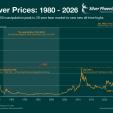
Schiff said the sharp move in silver prices above $66 an ounce reflects years of suppressed pricing finally giving way to monetary and supply-driven demand. He pointed to the break above $50 as a decisive technical event, noting that “there’d be no more resistance” once silver had reached $50.
Looking ahead to 2026, Schiff characterized $100 silver as “a very realistic target,” adding that prices could move higher if monetary instability accelerates. He also expects gold to reach at least $5,000, noting that silver’s growth often signals deeper stress in the financial system.

Mining Stocks Lag Despite Record Margins
Despite strong gains in precious metals equities in 2025, Schiff said mining stocks remain undervalued relative to current metal prices. He highlighted historically wide margins, noting that many producers are mining gold at costs near $1,500 an ounce while selling into prices above $4,300. “Even if the metal pulls back, where they’re pulling back to is still much higher than what’s priced into these stocks,” Schiff said. He expects earnings growth in 2026 to force a repricing across the sector.
Schiff cited rising dividends, share buybacks, and the potential for increased deal activity as key catalysts, especially among junior and mid-tier miners. He believes major producers may find it more economical to acquire established deposits than to fund new exploration and development, creating opportunities further down the mining food chain.
Bitcoin, Capital Rotation, and Policy Risk
On Bitcoin, Schiff remains critical, arguing that much of the retail capital that flowed into digital assets over the past decade came at the expense of gold and silver. He said that the dynamic is now reversing as precious metals outperform.
As liquidity conditions shift, Schiff believes investors who abandoned metals for crypto may return, even if doing so means owning fewer ounces than before. He said the renewed strength in gold and silver reflects a broader rotation away from speculative narratives and toward tangible assets.
Dollar Risks and the 2026 Trigger
Looking ahead, Schiff said the greatest risk for 2026 is a loss of confidence in U.S. fiscal and monetary credibility. He pointed to the possibility of a failed Treasury auction as a potential catalyst, forcing the Fed to step in more aggressively as the buyer of last resort.
While the specific trigger is impossible to predict, Schiff stressed the importance of positioning early. “You have to already be pretty much out of the dollar,” Schiff said, so that “when the crisis happens, you don’t have to scramble to react to it.”
He also noted that if capital flight accelerates, policymakers could attempt to impose controls, a move he believes would further boost demand for physical gold and silver held outside the financial system.
The 2026 Outlook
Schiff said 2026 is shaping up to be a year defined by inflation volatility, balance sheet expansion, and a shift in capital flows away from crowded trades. As political rhetoric collides with market signals, he expects precious metals and mining equities to play a central role in how investors navigate the next phase of the cycle.
KitcoNews