Silver supply remains dislocated, and prices should go higher before they retreat – Sprott CIO Smirnova
NEW YORK (December 8) The supply problems that have plagued the silver market in 2025 remain unresolved, and surging investment demand has only exacerbated physical shortages where they’re most needed, according to Maria Smirnova, Managing Partner at Sprott Inc. and Senior Portfolio Manager & Chief Investment Officer at Sprott Asset Management.
In a recent interview with Kitco News, Smirnova said silver’s price momentum has been building for some time, but the key threshold was crossed in the early summer.
“I think the important date was in June when silver broke through $35,” she said. “What has been building up to this point? First of all, for the past seven years or so, we have been in a fundamental supply/demand deficit. In fact, if you look at mine supply over the last 10 years, it has declined around 80 million ounces. Now total supply is about one billion ounces, so it's a very small market. And when you say that we're losing supply over the last 10 years, that tells you we're not finding and building new silver mines.”
At the same time, Smirnova pointed out, demand has been rising steadily. “Industrial demand has been growing, and a lot of it has been due to electronics and solar panels and electric vehicles,” she said. “Now we’re talking about AI centers, data centers, all of these electronic and electricity-type uses. As the use of electricity and AI and all of that grows, we need more and more silver, and supply has just not kept up. So this has been building for several years.”
The pushback to this bullish structural case for silver has been its high above-ground inventories – but these have also been in steady decline.
“When we talk about stock exchange inventories, we talk primarily about London’s LBMA, COMEX in New York, Shanghai in China,” she said. “Those inventories, as of a few years back, started declining. Specifically in London, for example, this year what's happened is some of the metal was shipped from London to New York because of fear of tariffs. At the same time, as ETFs have grown, they have reduced the available silver in London as well. So there's been a bit of a squeeze in London.”
“But again, with the backdrop of deficits, there's not much new metal coming in.”
As for the short-term catalyst that drove silver to fresh all-time highs in recent weeks, Smirnova said it came from the other side of the demand equation.
“Silver is still half monetary metal, so it follows gold in the sense that when interest rates go down – and we talk about the Fed wanting to do QE again and reduce interest rates – that will drive both gold and silver,” she said. “We talk about the dollar going down again, and that's what's happening the last few days.”
She added that the decline of digital assets is also boosting interest in precious metals. “Bitcoin and the rest of them have been melting down recently, so there's a big realization that, ‘Hey, wait a minute, it's gold and silver that are monetary metals, and real monetary assets,’” she said.
“Again, silver's a very small market,” she said. “If you think about a billion ounces, it's about $60 billion a year [at current highs] that we're making. It's nothing. That doesn't take a lot to move the price of silver.”
Smirnova said the shift in the physical shortages from London to Shanghai is also significant, because while the investment demand may be centered in the UK and U.S., the metal is actually being consumed in China.
“In my mind it's more important to look at solar, because that's where the panels are made,” she said. “Solar consumes over 200 million [ounces], or about 20% of supply. So, if we're saying in China that the inventories are out, that's very significant, because that's where the metal needs to go.”
And Smirnova said the ramping up of investment demand is happening while the physical supplies are as thin and as dislocated as they’ve been in many years.
“On the ETF side, from January until now we've had over a hundred million ounces go into the Western ETFs, at least what's tracked on Bloomberg,” she said. “Again, that's a big amount of silver.”
“I'll give you how I think about it: a big silver mine is between 10 and 20 million ounces of silver,” she added. “There's not that many mines like that, and we've not had new mines like that at all, really. And in the last 10 years, we've lost 80 million [ounces] of supply from mining. That's a handful of big mines that we need to replace.”
Meanwhile, other industry changes that occurred while silver prices languished are also negatively impacting present and future supply.
“What has happened in the last several years is a lot of the silver companies have actually bought gold assets, because they've realized it's easier to make money in gold – at least at the old prices, when silver was $20, nobody could make money in silver,” Smirnova said. “So their focus changed to finding gold mines, buying gold mines, and a lot of the miners have actually become more gold mining companies than silver mining companies.”
Now, the major players are being forced to scramble to acquire silver mines. “In this calendar year, we've had three or four M&A transactions where now the companies are trying to buy silver deposits and silver mines, but there's a shortage of them,” she said. “There's not many good assets in the space.”
“It will take time to permit these things, to finance them and build them,” she added. “In my mind, it's a five-to-10-year process; it's not an immediate fix.”
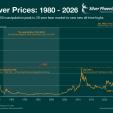
“After five to seven years of deficits, we're finally seeing the effects of that translate into price movement.”
Going forward, Smirnova said silver’s supply dynamics – and its future price action – depend in large part on whether China is able to import silver to fulfill their industrial needs.
“Who’s the marginal seller at this point?” she asked. “Is it still London, or is it going to start moving from the COMEX now? And how much is available? Or are the investors going to empty the Swiss vaults all of a sudden? And do people sell their silver at $60?”
For all these reasons – and even at these all-time-high prices – Sprott remains bullish on silver in the medium term.
“On a technical level, and I'm quoting our market strategist Paul Wong right now, he's seeing the first stop at $60, the next stop at $63,” she said. “We do follow another technical analyst, Michael Oliver. He is predicting $100 to $200 in the next few quarters.”
“These are not my numbers, but there are people out there who thinks the cat's out of the bag, and it's been building for a long time.”
KitcoNews